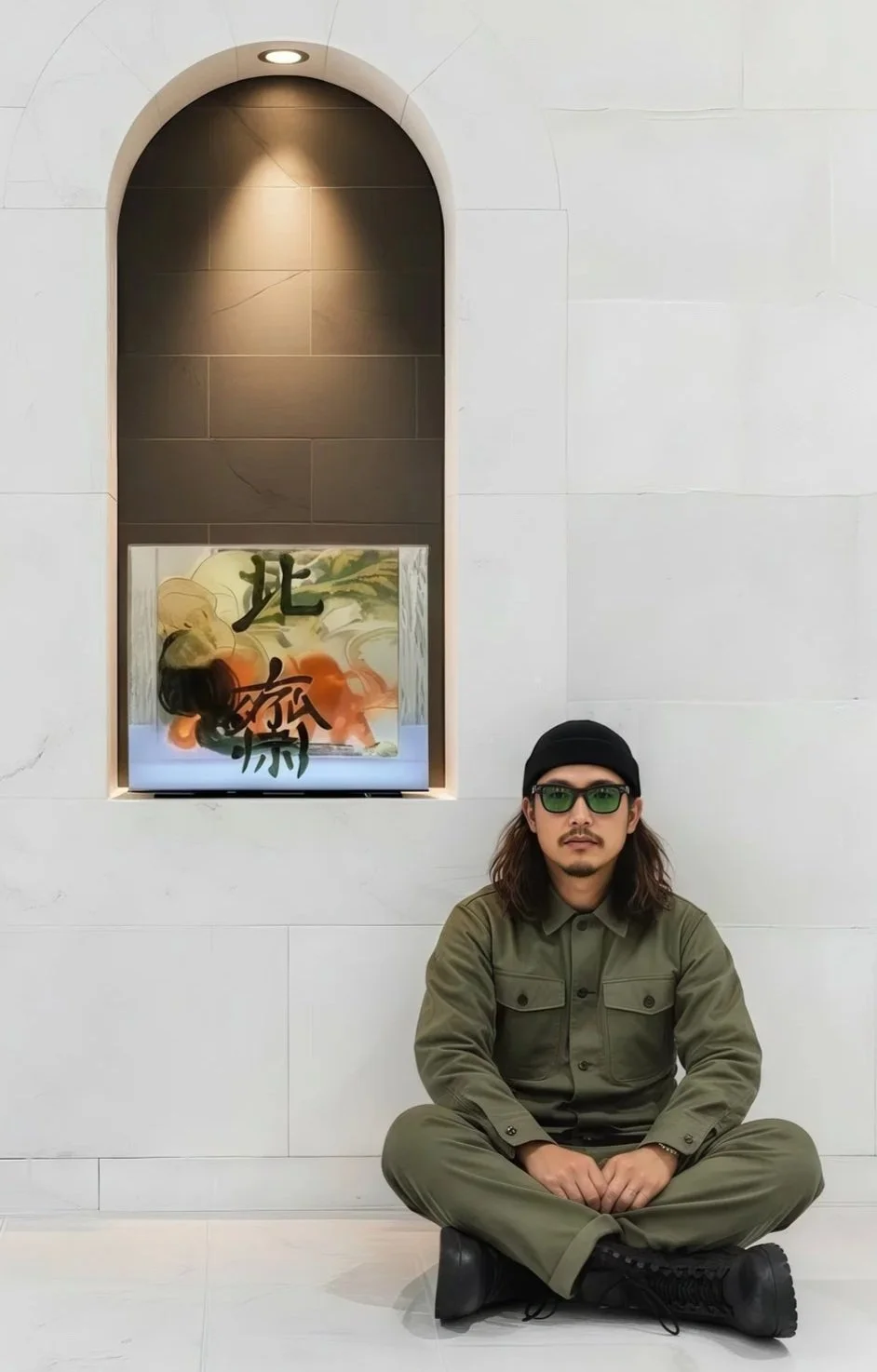
In the series Twin Odes to Hokusai : A Legacy Unfolded, Hiro Ando offers a bold reinterpretation of Hokusai’s legacy through a distinctly contemporary visual language rooted in the Nippon Neo-Pop movement. Replacing the flat surface of the traditional print with illuminated plexiglass constructions, Ando transforms imagery into spatial experience, inviting viewers to step inside the artwork itself. Each composition is structured around luminous cubes: one houses a small octopus sculpture, the other a fish, both contained within a second inner cube, as if memory itself were preserved within a modern architectural shell. The orange resin octopus evokes the sensual and mythic dimension of The Dream of the Fisherman’s Wife, while the blue fish resonates with the fluid and universal power of The Great Wave. Poetry and calligraphic fragments printed on the transparent surfaces multiply layers of perception, creating a visual palimpsest where narrative, sculpture, and historical imagery coexist. Rather than quoting Hokusai, Ando allows his spirit to breathe within a contemporary vocabulary, transforming ukiyo-e heritage into an immersive sculptural object. The series also reflects contemporary society, where images, memories, and cultural references overlap like translucent urban screens. Suspended in light, the marine creatures become metaphors for submerged desires, instinctive forces, and the constant flux shaping modern identity. Psychologically, Ando appears here as an artist navigating between reverence for Japanese tradition and the necessity of reinterpreting it for a global audience. His work reveals a tension between collective memory and personal imagination, between contemplation and visual seduction. Ultimately, Twin Odes to Hokusai stands not merely as homage but as a sculptural rebirth of Hokusai’s universe, where poetry, light, and form converge to offer a contemporary meditation on desire, nature, and the enduring vitality of art within an ever-changing world.
Whispers of the Deep : Intertwined Desires